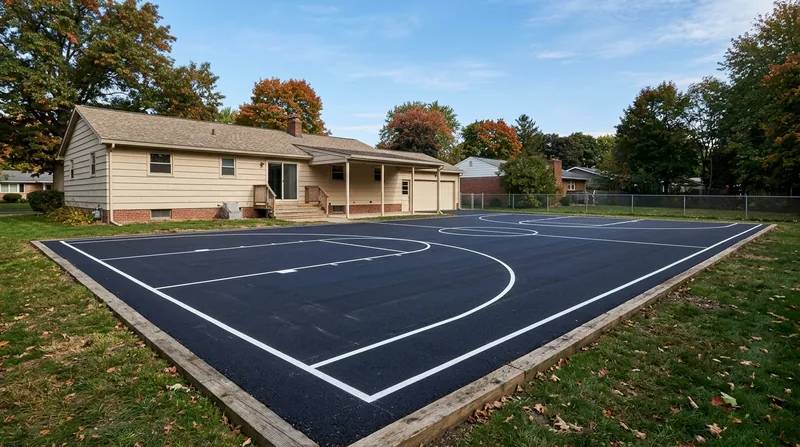




A backyard basketball court, tennis court, or walking path in Rochester needs more than just asphalt poured on dirt. Our clay-rich lake-plain soil holds water and holds cold, and Sports Court & Path Paving in Rochester demands a base built for the freeze-thaw cycle that dominates this region from November through February. We grade for drainage, compact the aggregate base, and lay a smooth asphalt surface that flexes through heave without cracking, so your court or path stays playable and safe through lake-effect winters and spring thaw. Whether you are installing a court for a school, a municipal park, a private residence in Pittsford or Greece, or a subdivision common area, the difference between a court that lasts ten years and one that fails in three is the base and the drainage. We have been building that foundation since 2014.
Why Sports Court & Path Paving Matters in Rochester: Freeze-Thaw and Clay Soil
Rochester's winters are not kind to asphalt that sits on an inadequate base. The clay-rich soil under most of our city and suburbs holds moisture, and when that moisture freezes, it expands and pushes the asphalt upward, a process called frost heave. A court or path built without proper grading and compacted aggregate will crack, settle unevenly, and develop ruts and soft spots by the third season. The freeze-thaw cycle repeats forty to sixty times between December and March in a typical Rochester winter, and each cycle works at the base. Lake-effect snow brings repeated plowing and salt, which accelerates edge deterioration and widens cracks. A properly built base and correct drainage are not luxuries; they are the difference between a court you can use year-round and one that becomes unsafe and unplayable.
- We grade the site to slope away from the court surface and shed water, preventing pooling and subsurface saturation.
- We compact the aggregate base in lifts to the density required for Rochester's clay-rich soil, using proof rolling to verify bearing capacity.
- We lay binder and surface course asphalt at the thickness specified for the intended use, whether recreational play or high-traffic paths.
- We finish with a smooth, even surface that meets sport-court standards for slope and texture.
A well-built court base holds through the Rochester winter and the spring thaw that follows. For guidance on what your municipality requires for court permits and stormwater compliance, check with your local building department; rules vary across Rochester, Irondequoit, Gates, Brighton, and other jurisdictions in Monroe County.
Key info: Rochester's frost line sits at approximately 3 feet 6 inches below grade. A court built without accounting for that depth and the clay soil's water-holding capacity will heave and crack within two to three seasons, even if the asphalt itself is high-quality. Proper base preparation is the single most important step.
How We Build a Sports Court or Path in Rochester: Grading, Base, and Paving
A court or path job starts with the site. We visit to assess drainage, soil conditions, and the existing grade, then we develop a plan that accounts for Rochester's clay and the freeze-thaw cycle. Grading is not cosmetic; it is structural. We remove unsuitable material, build the base to specification, and compact it in layers so that the asphalt sits on a stable, well-draining foundation. For detailed information on the grading and base-preparation process, see our Gravel Driveway Installation and Grading page, which covers the same base-building principles.
- We stake and survey the site to establish the correct elevation, slope, and drainage pattern for your court or path.
- We excavate and remove unsuitable soil, then build up the base with compacted crushed stone or recycled asphalt millings.
- We proof-roll the base to verify it is solid and capable of supporting the asphalt and the load that will be placed on it.
- We lay the asphalt binder course, then the surface course, finishing to the smoothness and slope required for the court type.
- We allow the asphalt to cure for six to twelve months before any sealcoating, so the material can fully harden and stabilize.
The timeline for a typical residential or small community court is three to five working days, depending on site conditions and weather. Larger installations or those requiring extensive grading may take one to two weeks.
Example: A basketball court in a Pittsford subdivision required removal of 18 inches of clay and replacement with 12 inches of compacted aggregate base plus 3 inches of asphalt. The clay was saturated and unsuitable; without removal and replacement, the court would have heaved within one season. Proper base work cost more upfront but delivered a court that has played true for eight years.
Sports Court and Path Paving Methods: What Works in Rochester
| Method | Description | Best for |
|---|---|---|
| Full-Depth Asphalt | Binder and surface course asphalt over a compacted aggregate base, built to Rochester frost depth and drainage requirements. | New courts, paths, and high-traffic recreational surfaces; the standard for basketball, tennis, and multi-sport courts. |
| Recycled Asphalt Millings Base | Compacted crushed asphalt as the base layer, with hot-mix asphalt surface course on top. Reduces material cost and recycles old pavement. | Budget-conscious court installations and walking paths where new asphalt surface is required but base can be recycled material. |
| Tar and Chip Surface | Liquid asphalt binder sprayed over stone chips, compacted and cured. Lower cost, rustic appearance, softer underfoot. | Walking paths, recreational trails, and low-speed surfaces where a traditional asphalt court is not required. |
| Overlay or Resurfacing | New asphalt surface laid over an existing base, if the base is still sound and not heaving or settling. | Existing courts or paths with minor cracking or wear but a solid, well-draining base underneath. |
Each method is chosen based on the site conditions, the intended use, and the budget. For a new court in Rochester, we almost always recommend full-depth asphalt with proper base grading, because the freeze-thaw environment demands it.
Sports Court and Path Paving Cost in Rochester: What to Expect
A typical sports court or path paving job in Rochester starts at $8,500 and ranges from there depending on the size of the surface, the condition of the existing site, and the depth of base preparation required. A 4,000-square-foot basketball court with proper base grading on clay soil typically runs $12,000 to $18,000. A walking path of 2,000 square feet with minimal grading may fall in the $6,000 to $9,000 range. A tennis court (approximately 2,600 square feet) with full base preparation usually runs $9,000 to $14,000. These are ballpark figures; the real cost depends on what is under the surface.
The biggest cost drivers are site conditions and base depth. If the existing soil is clay-rich and saturated, we remove it and replace it with compacted aggregate, which adds labor and material. If the site has poor drainage or existing settlement, we build a thicker base to stabilize it. If the court is large or the site is steep, grading becomes more complex. Access also matters: a court in a tight residential lot costs more to build than one on an open site where equipment can move freely.
We provide a free, no-obligation estimate after visiting the site and measuring the area. We include tonnage specifications and base depth on every written estimate, so you know exactly what you are paying for. See our pricing page for more detail on what moves the cost up or down, and call us at (585) 514-4903 to schedule your estimate.
Sports Court and Path Paving Near Me: What to Look for When Hiring a Contractor
Hiring the right contractor for a court or path matters as much as the materials. The historic red flags in paving are the same everywhere: unsolicited door-to-door offers, no written contract, a large cash deposit upfront, out-of-state plates, and a price that is too good to be true. An honest contractor gives you a written estimate with tonnage and thickness on it, answers your questions about base preparation, and does not pressure you into a decision. Verify that any contractor you hire carries full insurance; ask for a certificate of insurance before work starts. Check references, especially for court or path work in your area, because that work is specialized and visible.
If your court or path is in a municipality that requires a permit, ask your contractor to help you navigate the permitting process; rules vary across Rochester, Irondequoit, Gates, Brighton, and other towns in Monroe County, so verify with your local building department. If your court is in an HOA community, check the architectural guidelines before you commit, because some HOAs have rules about asphalt color or thickness. We are familiar with permitting across Greater Rochester and can guide you through the local requirements. Call us at (585) 514-4903 or contact us online to discuss your project and get a free estimate.
Sports Court & Path Paving in Rochester: Pricing Guide
| Service | Price | Details |
|---|---|---|
| Walking path or recreational trail | Starting at $5,500 | Tar and chip or recycled millings surface on prepared base, typical 1,500 to 2,500 square feet, minimal grading required |
| Small residential court or driveway court | Starting at $8,500 | Full-depth asphalt with compacted base, approximately 2,000 to 3,000 square feet, includes proper grading for Rochester clay soil |
| Basketball or tennis court with full base prep | Starting at $12,000 | Binder and surface asphalt, 2,600 to 4,000 square feet, includes site excavation, unsuitable soil removal, and compacted aggregate base |
| Large community court or multiple courts | On estimate | Scope, site conditions, drainage requirements, and access determine cost; free site visit and written estimate with tonnage specifications |
| Travel and estimates | Included | No separate mileage fee for Rochester and surrounding Monroe County communities; free estimate within 24 hours of request |
Indicative pricing, the exact cost depends on square footage, finish, and site access. Free personalized estimate within 24h at (585) 514-4903.


